
The French exiled him for fifteen years to break his movement. They sent him to the equatorial forests of Gabon, then to the Mauritanian desert, then held him under house arrest until his death.
By the time they gave up, Cheikh Ahmadou Bamba’s following had grown from a village to a nation-shaping force — and he had never raised a weapon.
Born Into Scholarship, 1853
Ahmad Ibn Muhammad Ibn Habiballah was born in 1853 in Mbacké-Baol, a village in the kingdom of Baol founded by his own great-grandfather, Maharam Mbacké.
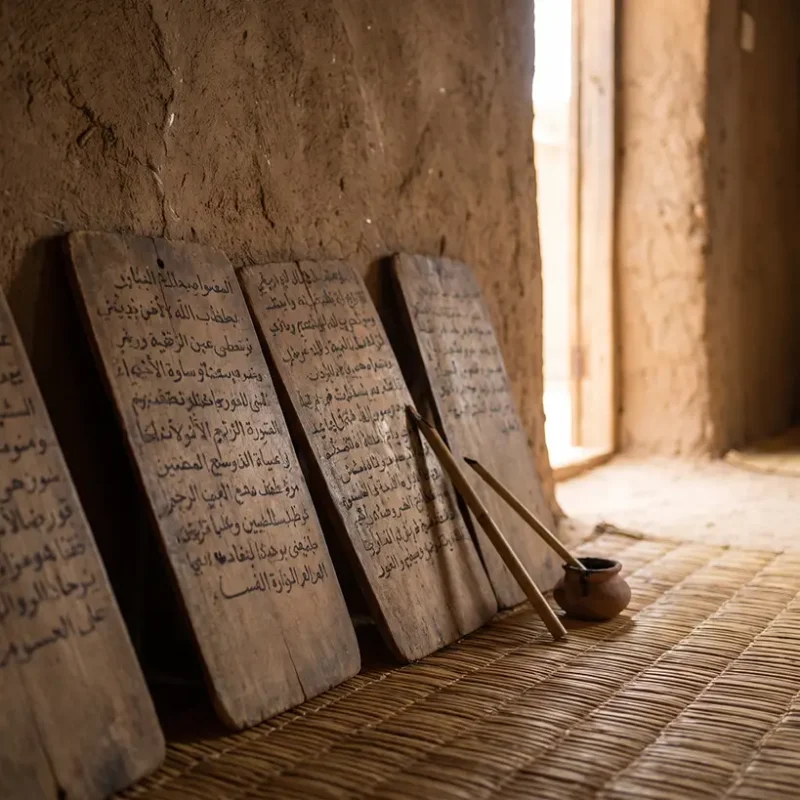
His father, Momar Anta Sali, was a respected qadi — an Islamic judge and scholar who ran Qur’anic schools. His mother, Sokhna Diarra Bousso, is remembered in Senegal for her devotion and generosity, and remains a venerated figure in her own right.
Accounts of his childhood describe a boy with little interest in play, who preferred imitating his father’s devotions. He mastered the Qur’an young, then moved through jurisprudence, theology and the Islamic sciences.
Founding the Mouridiyya
His father died in 1882. Bamba, then in his late twenties, was expected to inherit his position as a religious teacher aligned with the local courts.
He refused. Instead, around 1882–83, he founded his own path: the Mouridiyya — from the Arabic murīd, “one who desires” or “one who seeks”.
What he built was distinct from the brotherhoods around it in one crucial respect. Bamba taught that devotion is expressed through work — honest, disciplined labour — as much as through study and prayer. Everyone had a way in, scholar or not.
He also refused politics entirely. Where other religious leaders sought influence with kings and, later, colonial administrators, Bamba withdrew from all of it.
The Refusal to Fight
This is the moment that defines him.
In the 1880s, as the French pressed deeper into Senegal, the Wolof kingdoms were collapsing. Alboury Ndiaye, king of Djolof, urged Bamba to take up arms and join the armed resistance — around the time of the battle of Dékhelé in October 1886.
Bamba refused. Not from weakness or accommodation, but from principle. He taught the jihād al-akbar, the “greater struggle” — the internal battle against one’s own ego and base instincts. He called it jihādu nafs. The real war, in his teaching, was fought against the self, not against people.
His answer to colonial power was to build something the colonisers couldn’t touch: schools, farms, communities, and a body of written work.
Touba: A City Born From a Vision
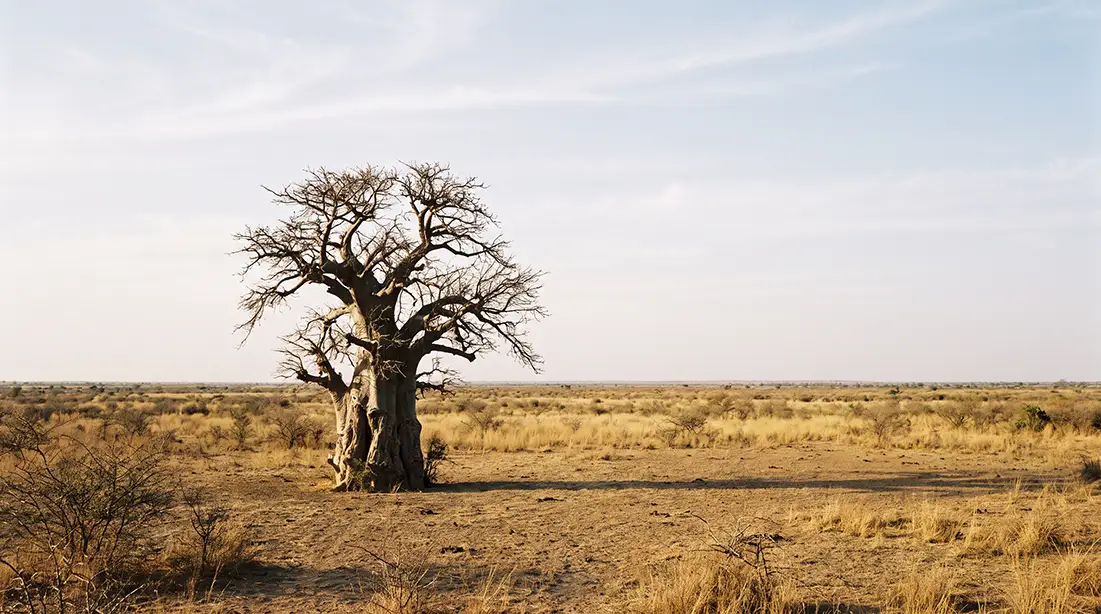
Around 1887, in the wilderness of Baol, Bamba is said to have received a vision beneath a lone tree — thousands of pilgrims converging on that spot.
He named the place Touba, after a tree mentioned in Islamic tradition as growing in paradise.
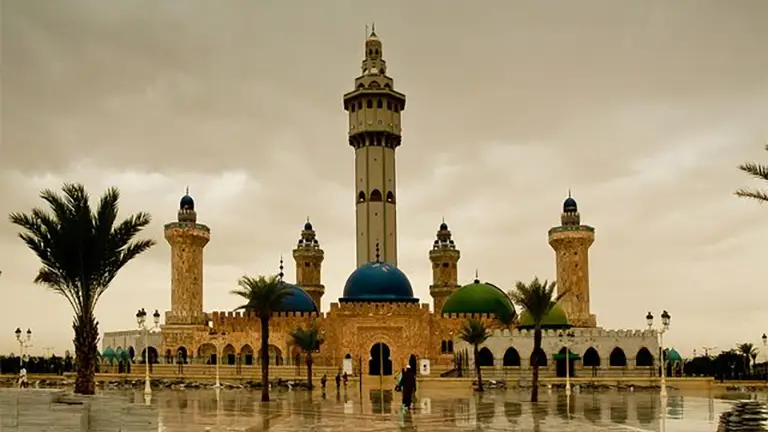
What was empty scrubland became, over the following century, the second-largest city in Senegal and the site of one of the largest mosques in Africa. It runs under its own rules — no alcohol, no tobacco, no nightlife — and is administered by the Mouride caliphate rather than the state.
Bamba is buried inside the Great Mosque. Read more in our guide to the Mouride Brotherhood.
Fifteen Years of Exile
Gabon (1895–1902)

By 1895 the French had decided he was a threat. His following was growing at a rate they couldn’t explain, and a religious leader with that many disciples was, to a colonial administration, a rebellion waiting to happen.
He was summoned in August 1895, arrested on the road, taken to Saint-Louis and brought before the colonial council. Their own report conceded that no evidence of preaching holy war had been found against him — and they exiled him to Gabon anyway.
He spent roughly seven years in the equatorial forest, in conditions meant to kill him.
Mouride tradition holds that when he was denied space to pray aboard the ship, he prayed on the surface of the ocean. Whether taken as literal miracle or as parable, the story carries the same meaning for those who tell it: no power on earth could come between him and God. It is one of the most reproduced images in Senegalese popular art.
Mauritania (1903–1907)
He survived Gabon and returned — to a following that had multiplied rather than dispersed. The French exiled him again, this time to the Mauritanian desert.
The same thing happened. Each attempt to erase him confirmed, for his disciples, that he was under divine protection.
House Arrest in Diourbel
Eventually the administration changed tactics. Rather than exile him further, they confined him to Diourbel under surveillance, where he remained for the rest of his life.
He used the time to write.
The Written Work
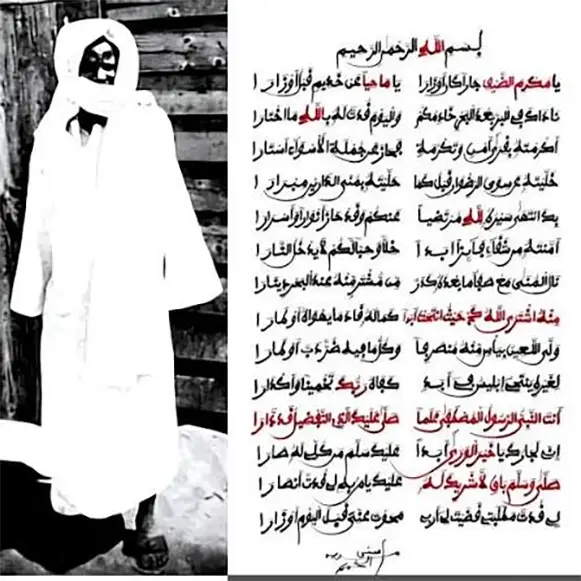
Bamba produced a substantial body of writing — devotional poetry, Qur’anic commentary, jurisprudence, and guidance for his disciples. The Massalik al-Jinan (“Itineraries to Paradise”) remains central to Mouride devotion.
His disciples memorise and chant these texts. Verses appear in calligraphy on walls, on buses, on fabric. The writing is not archived — it’s in daily circulation.
Khadimou Rassoul
He is known across Senegal by two names.
Serigne Touba — the Master of Touba.
Khadimou Rassoul — Servant of the Messenger. This is the name he chose for himself, and it captures the whole approach: not leader, not conqueror, not saint. Servant.
That framing is what made service — khidma — the organising principle of Mouridism, and what allowed Cheikh Ibra Fall to build the Baye Fall movement on the idea that work itself is worship.
Death and the Grand Magal
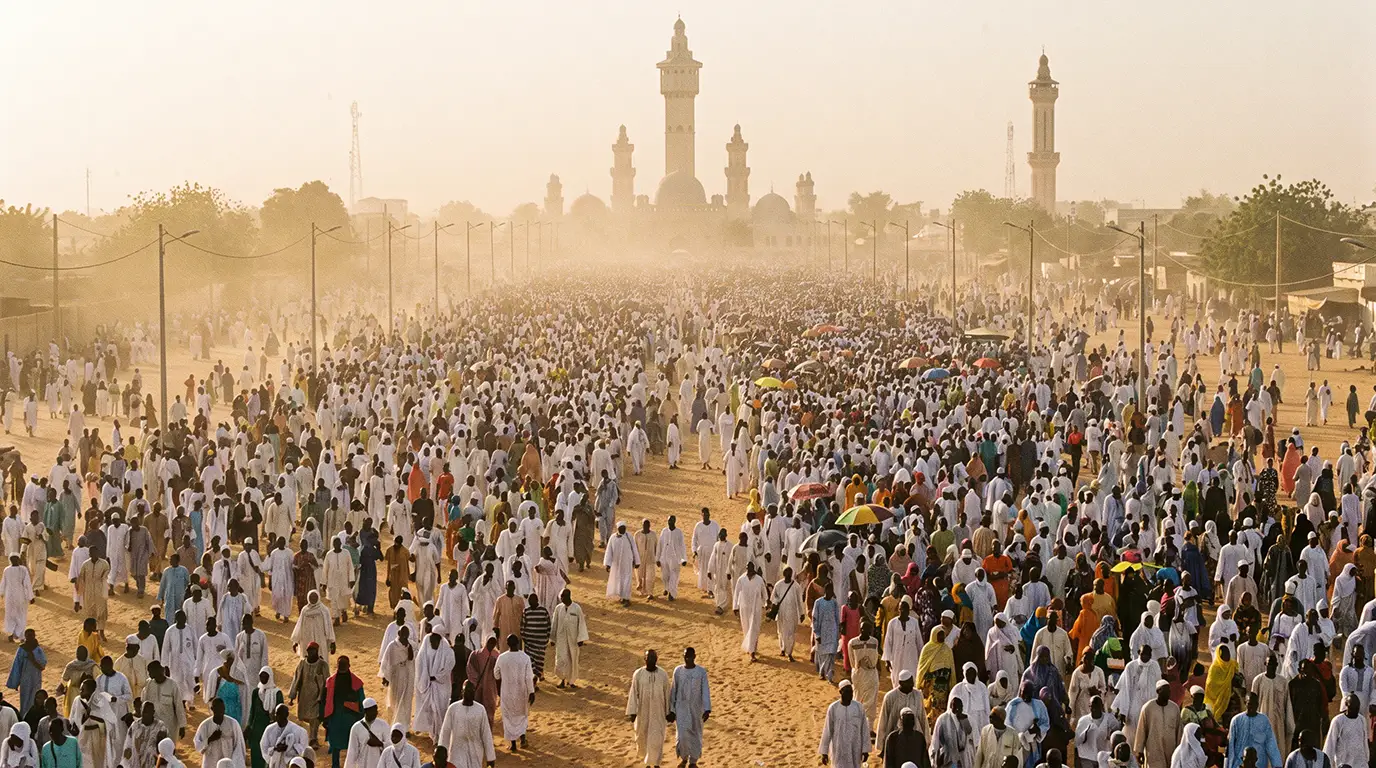
Cheikh Ahmadou Bamba died on 19 July 1927 in Diourbel. His body was taken to Touba.
Each year on 18 Safar in the Islamic calendar, millions travel to Touba for the Grand Magal. It commemorates not his birth or his death, but his departure into exile in 1895 — because in Mouride understanding, that was the moment his spiritual authority was proven rather than defeated.
Pilgrims come to give thanks for the trial. More in our article on the Grand Magal of Touba.
What He Left Behind
A century after his death, the effects are visible everywhere in Senegal and wherever Senegalese people have settled.
- An economic culture. Mouride traders operate networks running from Dakar’s markets to Brooklyn, Milan and Paris, with earnings circulating back into schools, mosques and clinics.
- A city. Touba grew from a vision under a tree into Senegal’s second city.
- A model of resistance. He demonstrated that refusing to fight is not the same as submitting — a lesson studied well beyond Senegal.
- A visual language. His single known photograph, taken in 1913, is reproduced on murals, car rapides, tapestries and shopfronts across the country.
Wearing the Heritage
Baye Fall Spirit exists inside this tradition. The njaxass patchwork, the imagery, the philosophy of work as worship — all of it descends from Bamba through Cheikh Ibra Fall.
Read more on Mame Cheikh Ibrahima Fall’s legacy and Baye Fall history, or browse the collection.
Fifteen years of exile intended to erase a man. It built a brotherhood instead.
BayeFall Legacy: Wear the Story.
